Choosing the right compressed air tank decides whether your onboard air system runs load assist airbags, tyre inflation and air lockers reliably in 2026 — or leaves the compressor cycling every time you open a valve. This guide ranks the tank configurations that suit Australian 4WDs, utes, vans and caravans, matched to the job each one actually does best. Best overall for combined load assist and tyre inflation duty: a mid-size multi-port aluminium tank. Best for turnkey setups: a complete onboard air system kit. Best compact pick: a 1.5 gallon 5-port stubby aluminium tank.
- Best compressed air tank Australia pick for most setups: a mid-size multi-port aluminium tank running load assist and tyre inflation together.
- Best for turnkey caravan and camper setups: a complete onboard air system kit with tank, compressor and management pre-matched.
- Best compact option: a 1.5 gallon 5-port stubby aluminium tank suited to single-bag load assist top-up.
- Best for touring 4WDs cycling tyre pressure often: a larger multi-outlet tank sized for faster recovery.
- Best for custom builds: a DIY tank and fittings kit sized by a workshop or installer.
Why this matters
Australian onboard air setups get pushed hard by corrugated roads, heat, dust and salt air near the coast. A tank that's undersized forces the compressor to cycle constantly, which shortens compressor life and slows down every task.
Boss Air Suspension's onboard air range exists because the tank is usually the part buyers get wrong first, not the compressor. People spend money on a good 12V or 24V compressor, then bolt on whatever tank was cheapest, and the compressor ends up doing more work than it should.
The tank's job is to buffer air so the compressor isn't running every time a valve opens. Get the size and port count right and everything downstream — load assist, tyre inflation, air lockers — works with less wear on the compressor.
“A tank that's too small just means the compressor cycles more often — that's wear, not convenience.”
What makes the best compressed air tank
- Material and wall thickness — aluminium resists corrosion better than untreated steel in coastal and outback conditions
- Port count and layout — a 5-port tank covers a pressure switch, gauge, compressor feed and two accessory lines without adding a manifold
- Capacity matched to draw — sized to the compressor's output and the number of accessories, not just "bigger is better"
- Mounting footprint — chassis rail, tray or under-seat space dictates a stubby tank versus a longer cylinder
- Fitting compatibility — 3/8" push-fit ports suit standard airline without adapters
- Corrosion resistance for outback and coastal driving — a bigger factor in Australia than in tanks built for milder climates
At a glance: compressed air tanks ranked by use case
| Tank type | Best for | Standout feature | Key limitation |
|---|---|---|---|
| Compact stubby aluminium tank | Single-bag load assist top-up | 5-port layout in a short footprint | Limited reserve for high-draw accessories |
| Mid-size multi-port aluminium tank | Combined load assist + tyre inflation | Balances capacity with a bolt-in size | Needs a properly rated compressor to fill it quickly |
| Large multi-outlet tank | Touring 4WDs cycling tyre pressure often | Faster recovery between inflate/deflate cycles | Takes up more mounting space |
| Complete onboard air system kit | Turnkey caravan and camper setups | Tank, compressor and management pre-matched | Less room to customise individual components |
| DIY tank and fittings kit | Custom builds and workshop installs | Buyer sizes tank, valves and lines to the job | Requires more planning before ordering |
1. Compact stubby aluminium tank: best compressed air tank for single-bag load assist top-up
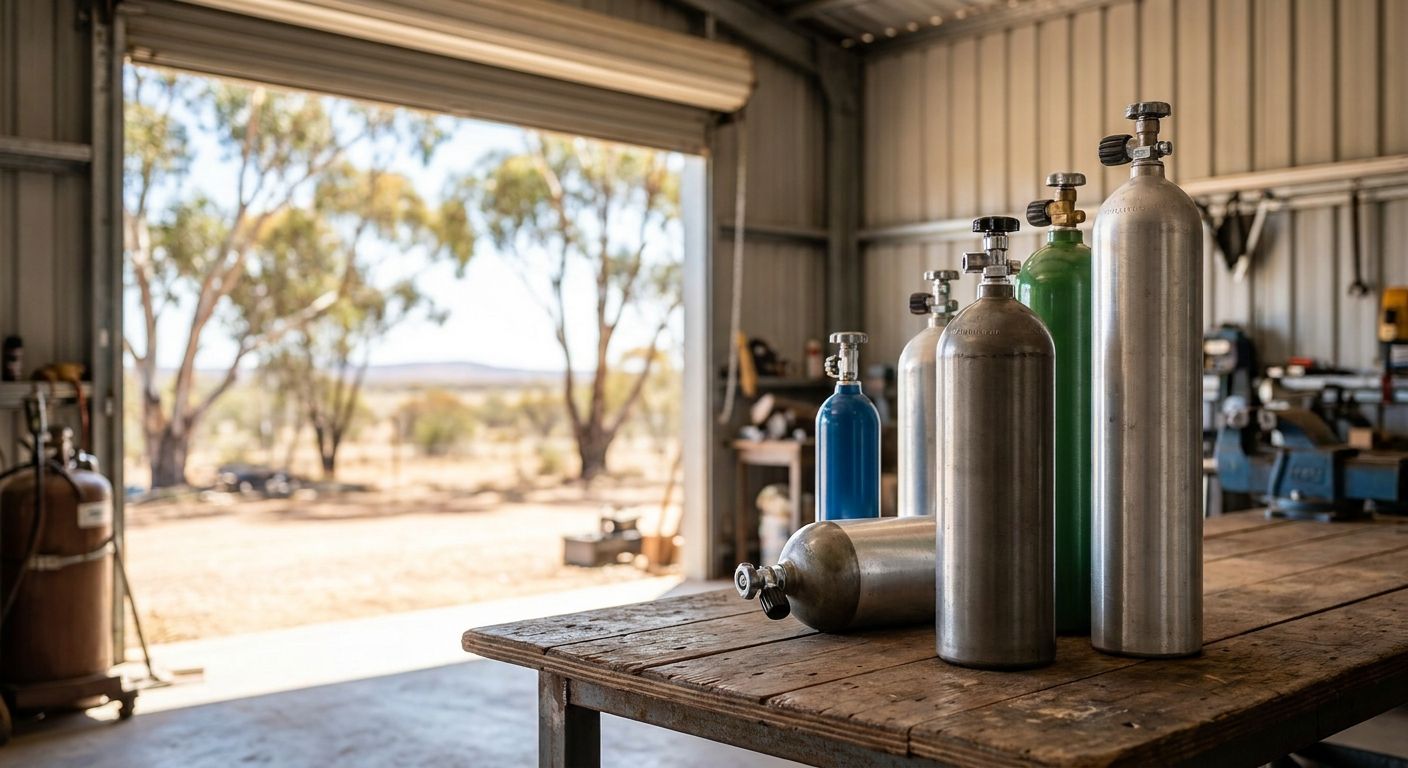
A compact aluminium tank built with a shorter body, such as the 1.5 gallon 5-port design Boss Air Suspension supplies, suits tight mounting spots under a tray or behind a bumper. It's built for compact air suspension and onboard air layouts where a shorter tank shape is the priority over raw capacity.
Compact stubby tank pros:
- Five ports cover switch, gauge, compressor feed and accessory line without an extra manifold
- Short body fits tight spaces where a full-length cylinder won't
- Aluminium construction handles Australian humidity and dust better than mild steel
Compact stubby tank cons:
- Limited reserve if you're running more than one high-draw accessory at once
- Not sized for continuous tyre inflation on a full set of 4WD tyres
Best for: a single load assist airbag top-up where mounting space is tight. Verdict: Buy — for a straightforward single-bag setup.
2. Mid-size multi-port aluminium tank: best compressed air tank for combined load assist and tyre inflation
A mid-size aluminium tank sits between the compact and large options, carrying enough reserve air to run a self-levelling load assist valve and top up a tyre without the compressor kicking in mid-task. Boss Air Suspension's aluminium air tank sizing guidance covers how to match this size to your setup.
Mid-size tank pros:
- Enough reserve for a load assist valve and a tyre top-up on the same tank
- Aluminium shell keeps corrosion in check on coastal or outback runs
- Multiple ports support a pressure switch, digital controller and two accessory lines
Mid-size tank cons:
- Needs a compressor rated to fill the extra volume, or fill times blow out
- Larger footprint than a stubby tank — check clearance before ordering
Best for: utes and 4WDs running load assist airbags and a tyre inflation kit off the same onboard air system. Verdict: Buy — the sensible default for most 2026 setups.
3. Large multi-outlet tank: best compressed air tank for touring 4WDs cycling tyre pressure often
Touring 4WDs that air down for sand or corrugations and reinflate at the servo need faster recovery between cycles. A larger tank holds more reserve air so a full set of tyres can be filled without waiting on the compressor to catch up. Sizing an air tank for a tyre inflation system walks through matching tank size to compressor output for this exact use case.
Large tank pros:
- Faster recovery between deflate and reinflate cycles
- Useful buffer for beach and outback touring where pressure changes are frequent
- Multiple outlets let two people air up at once
Large tank cons:
- Takes up more chassis or tray space than mid-size options
- Overkill for a vehicle that only tows occasionally
Best for: 4WD tourers who air down and reinflate regularly on sand, tracks or corrugated roads. Verdict: Buy if tyre cycling is a regular part of your trips; Hold if you tour rarely.
4. Complete onboard air system kit: best compressed air tank for turnkey caravan and camper setups
A complete kit pairs a tank with a compressor and air management components already matched to each other, so there's no sizing maths for the buyer. Boss Air Suspension's onboard air system for caravan and camper trailer owners covers what a matched kit includes.
Complete kit pros:
- Tank, compressor and management components sized to work together from the start
- Straightforward for owners who want tyre inflation and accessory air without designing the system themselves
- Removes the guesswork in matching compressor duty cycle to tank size
Complete kit cons:
- Less flexibility to swap in a different tank size later without affecting the rest of the kit
- A bigger upfront decision than buying a tank on its own
Best for: caravan and camper trailer owners who want a working onboard air setup without piecing it together. Verdict: Buy — for owners who want it sorted once and done.
5. DIY tank and fittings kit: best compressed air tank for custom builds and workshop installs
Workshops, suspension specialists and experienced builders often want to pick the tank size, valves and line routing themselves rather than take a packaged kit. A DIY onboard air tank fittings and hose kit is built for exactly this kind of build.
DIY kit pros:
- Buyer controls tank capacity, port count and fitting choice to match the exact build
- Suits multi-accessory setups — air lockers, load assist and tyre inflation run from one system
- Works well for tray and canopy fit-out builders wiring several outlets
DIY kit cons:
- Requires more planning up front — sizing a tank wrong here is a common mistake
- Not the fastest option if you just want something bolted on and working
Best for: workshops and experienced builders customising a full onboard air system. Verdict: Buy for builders who know what they're plumbing; Skip if you want a packaged answer.


How we ranked
Each tank type is scored against the criteria above: port count, capacity matched to draw, mounting footprint and corrosion resistance for Australian conditions. The ranking reflects how buyers actually use tanks in 2026 — for load assist top-up, tyre inflation, air lockers or a mix of all three — rather than treating capacity as the only variable that matters.
Which compressed air tank should you choose?
If you're unsure, the mid-size multi-port aluminium tank is the safest default for 2026 — it covers load assist and tyre inflation without over-committing to mounting space or compressor draw. Go compact stubby if your load assist kit only needs occasional top-ups. Go complete kit if you want the whole onboard air system sorted at once rather than sizing each part yourself.
Boss Air Suspension's onboard air tank range covers all five configurations above, and vehicle-specific fitment advice is available before you order rather than after.
FAQ
What size compressed air tank do I need for onboard air in 2026?
Tank size depends on what's running off it — a single load assist airbag top-up needs far less reserve than a full tyre inflation setup. Match capacity to the number of accessories and the compressor's output rather than picking the largest tank available.
Is aluminium or steel better for a compressed air tank in Australia?
Aluminium resists corrosion better in the humidity, dust and salt air common across Australian driving conditions. Untreated steel tanks are more prone to internal rust over time, especially in coastal regions.
Can one air tank run load assist airbags and tyre inflation together?
Yes, provided the tank has enough reserve capacity and enough ports for both circuits. A mid-size multi-port aluminium tank is generally sized for this combined use.
How many ports does an onboard air tank need?
Most setups need at least a compressor feed, a pressure switch and one accessory outlet. A 5-port tank covers this without adding a separate manifold.
Where should a compressed air tank be mounted on a 4WD or ute?
Mounting depends on available chassis, tray or under-seat space. Compact stubby tanks suit tight areas, while larger tanks need more clearance and a secure bracket.
Does a bigger air tank mean faster tyre inflation?
A larger tank holds more reserve air, which reduces how often the compressor has to run mid-task, but fill speed still depends on the compressor's duty cycle and output.
Is a complete onboard air system kit better than building one from parts?
A complete kit removes the sizing guesswork because the tank, compressor and management components are matched from the start. Building from parts gives more control but requires more planning.
How do I stop a compressed air tank from corroding?
Choosing an aluminium tank over untreated steel is the main defence, along with draining any condensation that builds up inside the tank over time.
One last thing
A 5-port tank often removes the need for a separate manifold entirely — one part rated for a pressure switch, gauge, compressor feed and two accessory lines, with nothing extra to fit. Before ordering any compressed air tank for 2026, count your actual outlets first; most buyers overbuy capacity and underbuy ports, when it's usually the other way around that solves the problem.