The best high flow air compressor for tyre fill in 2026 depends on how you actually use it. A twin-cylinder 12V compressor is the strongest all-rounder for remote touring 4WDs, a dual-outlet 12V unit wins when you need to fill two tyres on a tandem-axle caravan at once, and a 24V heavy-duty compressor is the right call for commercial fleet trucks running a 24V electrical system.
- The best high flow air compressor for tyre fill in 2026 for remote touring is a twin-cylinder 12V unit.
- Dual-outlet 12V compressors fill two tyres simultaneously, the fastest option for tandem-axle caravans.
- 24V heavy-duty compressors suit commercial fleet trucks and light trucks with 24V systems.
- Portable single-motor 12V compressors are the compact pick for occasional-use SUVs and utes.
- Tank-assisted onboard air systems deliver the quickest single burst fill for workshop and mobile tyre work.
Why this matters
Dropping tyre pressure for corrugations and sand, then bringing it back up for the blacktop, is routine for anyone touring in Australia. Many tourers run tyres down around 18psi off-road and need to get them back to 38-40psi for the highway, and a slow compressor turns that into a 20-minute stop at every gate.
Not every compressor labelled "high flow" performs the same under load. The real differentiator is duty cycle — how long the compressor can run continuously before it needs to rest — and that's the number worth checking before airflow claims. A side-by-side breakdown of duty cycle ratings across compressor types sits in the guide on air compressors ranked by duty cycle, and it's worth reading before you commit to a category.
This guide ranks high-flow compressor types by the job they're actually built for, not by which one looks fastest on a spec sheet.
What makes the best high-flow air compressor for tyre fill
- Duty cycle — the percentage of time the compressor can run before it needs a cool-down break
- Airflow delivery — how much air moves per minute, which drives fill speed on larger 4WD and light-truck tyres
- Outlet configuration — single-outlet units fill one tyre at a time, dual-outlet units fill two
- Voltage compatibility — 12V suits most passenger 4WDs and utes, 24V suits many commercial trucks
- Noise and mounting — portable units are louder and hand-held, onboard units are quieter and permanently plumbed
- Tank assistance — a compressor paired with an air tank delivers a fast initial burst, then tops up on demand
Compressor types at a glance
| Type | Best for | Standout feature | Key limitation |
|---|---|---|---|
| Twin-cylinder 12V | Remote touring 4WDs | Higher sustained duty cycle for repeated deflate/reinflate cycles | Bulkier than single-motor portables |
| Dual-outlet 12V | Tandem-axle caravans | Fills two tyres at the same time | Draws more current than a single-outlet unit |
| Portable single-motor 12V | Occasional-use SUVs and utes | Compact, stores in a glovebox or door pocket | Lower duty cycle, slower on repeated fills |
| 24V heavy-duty | Commercial fleet trucks | Matches 24V truck electrical systems | Not compatible with standard 12V vehicles |
| Tank-assisted onboard | Workshop and mobile tyre fitting | Fast burst fill from stored air, then compressor tops up | Needs a tank and mounting space |
1. Twin-cylinder 12V high-flow compressor: best for remote touring 4WDs
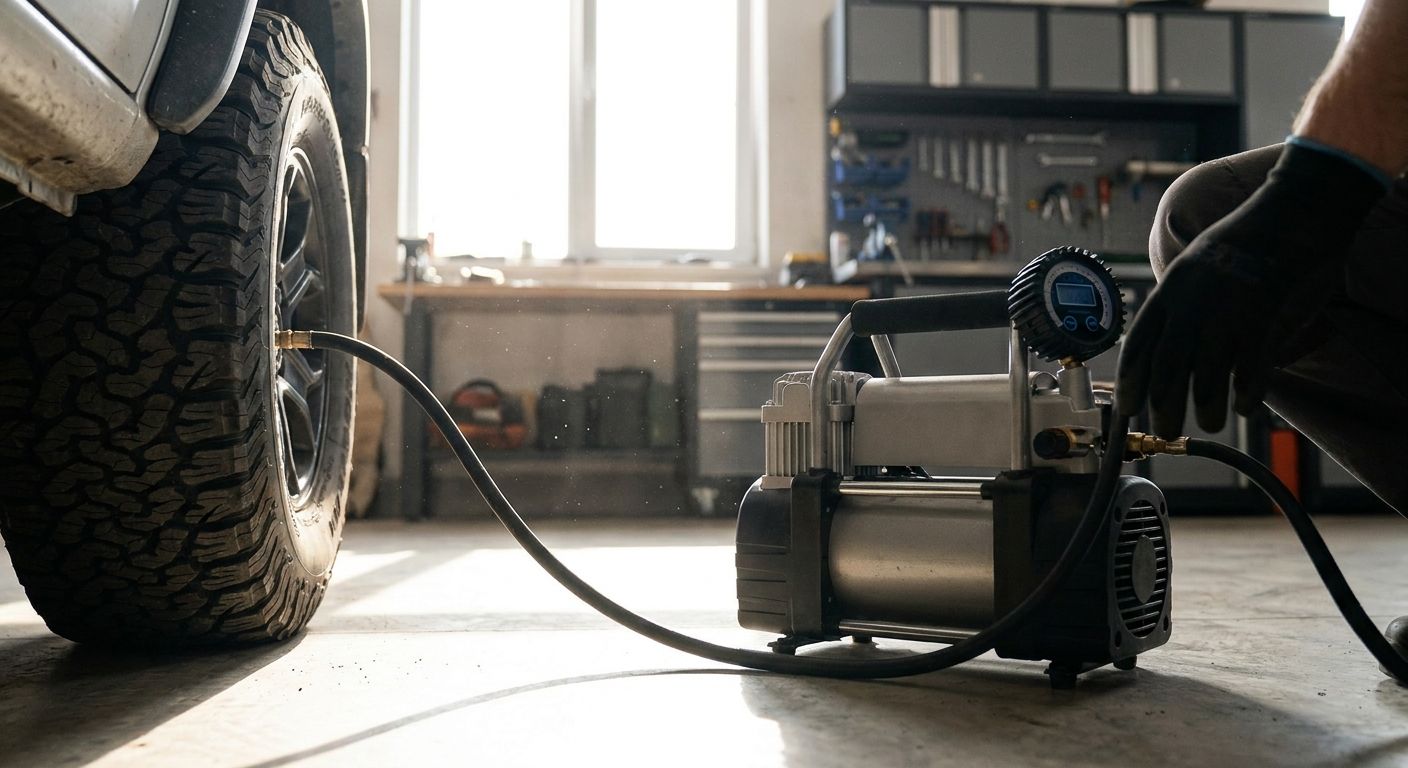
A twin-cylinder compressor runs two pumping cylinders off one motor, which lifts sustained airflow and duty cycle compared with a single-cylinder unit of similar size. For anyone airing down and back up multiple times on a single trip, that sustained running time matters more than a headline pressure figure.
These units are typically hard-wired as part of an onboard air setup, alongside an air tank and pressure switch, rather than plugged into a cigarette lighter. The full wiring and layout for a high-volume twin-compressor setup is covered in the guide on twin compressor setups for high-volume onboard air.
Twin-cylinder 12V pros:
- Higher duty cycle than most single-cylinder portables
- Handles repeated deflate/reinflate cycles on long touring days
- Usually hard-wired, so no fumbling for a cigarette lighter plug at a gate
Twin-cylinder 12V cons:
- Bulkier and needs a permanent mounting location
- Installation is more involved than a plug-in portable
- Overkill for a vehicle that's only aired down once or twice a year
Best for: touring 4WD owners who air down and reinflate regularly on corrugated or sandy tracks.
Verdict: Buy if remote touring is a regular part of how the vehicle is used.
2. Dual-outlet 12V compressor: best for simultaneous tyre fill on tandem-axle caravans
A dual-outlet compressor splits output across two hoses, so both tyres on a tandem axle come up to pressure together instead of one after the other. On a caravan with four or six tyres to check before a trip, that halves the time spent standing at the wheel arch.
The trade-off is current draw. Running two outlets from one compressor pulls more amps than a single-outlet unit of the same duty cycle rating, so wiring and fuse sizing need to match the load.
Dual-outlet pros:
- Cuts tyre check and inflation time roughly in half on paired axles
- Useful for caravans, box trailers and tandem-axle camper trailers
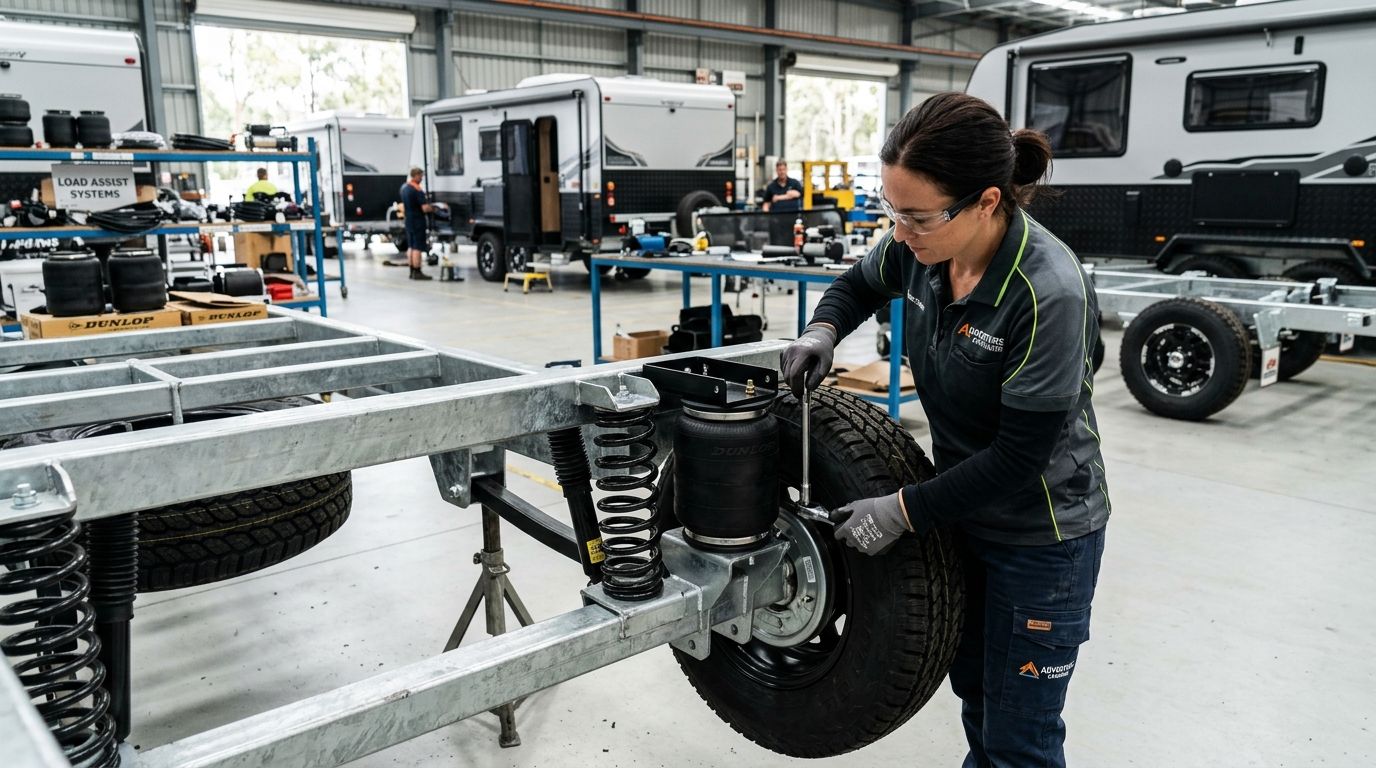
- Works well alongside a self-levelling load assist setup where ride height and tyre pressure both matter
Dual-outlet cons:
- Higher current draw than single-outlet compressors
- Not necessary on a single-axle vehicle
- Wiring needs to be sized for the combined load, not just one outlet
Best for: tandem-axle caravan and camper trailer owners doing pre-trip tyre checks.
Verdict: Buy if the trailer or caravan runs on tandem axles and pre-trip checks are a time pressure.
3. Portable single-motor 12V compressor: best for occasional-use SUVs and utes
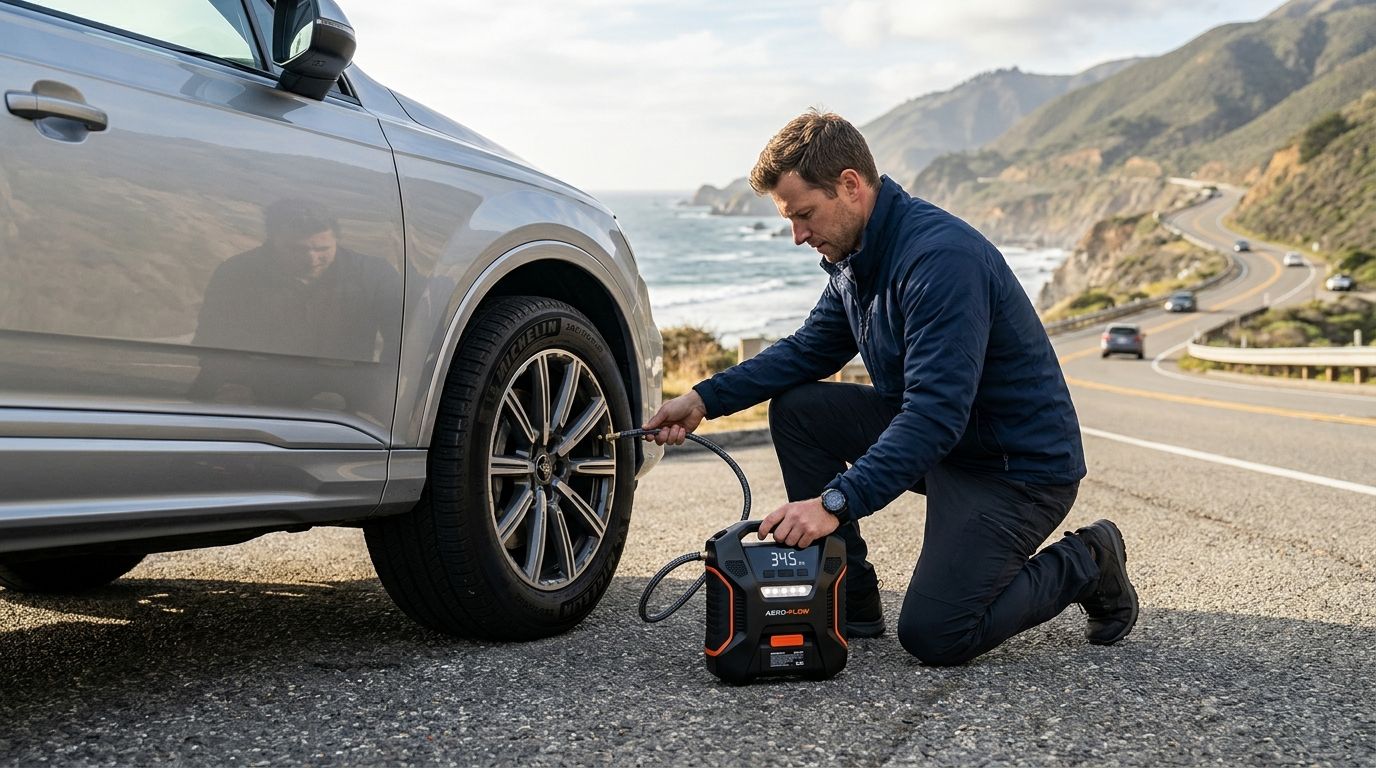
A portable single-motor compressor plugs into a 12V accessory socket, does the job, and packs away. It's the right fit for a vehicle that mostly runs on-road with the occasional dirt road or beach trip.
Duty cycle is the trade-off here. Portable units generally can't sustain the same continuous run time as a twin-cylinder onboard unit, so repeated full deflate-to-reinflate cycles across a full day of touring will push them harder. A side-by-side comparison of portable units by actual fill speed is in the guide on portable tyre inflators ranked by fill speed.
Portable single-motor pros:
- No permanent installation required
- Fits in a glovebox, door pocket or under a seat
- Suits a vehicle that only occasionally leaves the bitumen
Portable single-motor cons:
- Lower duty cycle than twin-cylinder or onboard units
- Slower on larger 4WD and light-truck tyres
- Needs to cool down between repeated full fills
Best for: SUV and ute owners who tow or tour occasionally rather than every weekend.
Verdict: Buy for occasional use; Skip if touring and airing down are a regular routine.
4. 24V heavy-duty compressor: best for commercial fleet and light truck work
A 24V compressor is built for the electrical systems found on many commercial trucks, not for a standard 12V ute or wagon. Fleet vehicles that run 24V systems need a compressor matched to that voltage — a 12V unit simply won't wire into a 24V system correctly.
For fleet operators, the appeal is consistency: one compressor spec across a fleet of similar 24V vehicles, rather than mixing voltage types across the yard. A closer look at 24V options built for this application is in the guide on 24V air compressors for commercial fleet vehicles.
24V heavy-duty pros:
- Matched to 24V commercial truck electrical systems
- Suits fleet standardisation across similar vehicles
- Typically built for higher-duty, repeated daily use
24V heavy-duty cons:
- Not usable on standard 12V passenger or 4WD vehicles
- Installation needs to match existing 24V wiring and fusing
- Limited relevance outside commercial and fleet applications
Best for: fleet operators and commercial vehicles running a 24V system.
Verdict: Buy for 24V fleet vehicles; Skip entirely on a 12V passenger vehicle or 4WD.
5. Tank-assisted onboard air system: best for workshop and mobile tyre-fitting use
Pairing a compressor with an aluminium air tank changes how the fill happens. The tank holds a reserve of compressed air, so the first burst into a tyre comes from stored pressure rather than waiting on the compressor motor, and the compressor then tops the tank back up in the background.
This setup suits workshops, mobile tyre-fitting vans and anyone running air tools alongside tyre inflation, where repeated fast bursts matter more than one continuous long fill. It's a bigger install than a plug-in portable, with a tank, pressure switch and manifold to mount and plumb.
Tank-assisted onboard pros:
- Fastest initial burst fill of any option here, drawing on stored air
- Supports multiple air outlets from one tank via a manifold
- Doubles as an air supply for tools, lockers or tyre inflation kits
Tank-assisted onboard cons:
- Needs mounting space for a tank in addition to the compressor
- More components to install and plumb correctly
- Not a fit for a vehicle with no spare mounting space
Best for: workshops, mobile tyre-fitting operations and vehicles already running an onboard air system.
Verdict: Buy for workshop or high-frequency use; Hold if a simple portable would already cover the job.


How this list was ranked
Each type was placed against the same six criteria: duty cycle, airflow delivery, outlet configuration, voltage compatibility, noise and mounting, and tank assistance. No single type wins on every criterion — a twin-cylinder unit beats a portable on duty cycle but loses on convenience, while a tank-assisted system wins on burst speed but demands more install space. The ranking reflects which criteria matter most for the use case named in each heading, not a single overall score.
“If a compressor needs a coffee break after filling one set of touring tyres, it isn't built for high-flow work.”
Which high-flow air compressor should you choose?
For most 4WD owners touring Australia in 2026, a twin-cylinder 12V compressor as part of an onboard air setup is the safest default — it handles repeated deflate and reinflate cycles without stalling on duty cycle. Tandem-axle caravan owners get more value from a dual-outlet unit, fleet operators need to match voltage with a 24V compressor, and anyone who only airs down a few times a year is better served by a portable single-motor unit.
If the vehicle already runs, or is being built to run, a broader onboard air system, a tank-assisted setup is worth the extra install effort for the fill speed it delivers.
FAQ
What is the best high flow air compressor for tyre fill in 2026?
For most touring 4WDs in 2026, a twin-cylinder 12V compressor wired into an onboard air setup is the best all-rounder because it sustains a higher duty cycle across repeated deflate and reinflate cycles. Fleet vehicles on 24V systems need a matched 24V unit instead, and tandem-axle caravans do best with a dual-outlet compressor.
Is a 12V or 24V air compressor better for tyre inflation?
Voltage isn't about which is better, it's about matching the vehicle's electrical system. Standard 4WDs, utes and wagons run 12V, while many commercial trucks run 24V, and the compressor has to match that system to wire in correctly.
How fast should a high-flow compressor fill a 4WD tyre?
Fill speed depends on tyre size, starting pressure and the compressor's airflow rating, so there's no single figure that applies to every vehicle. Duty cycle matters more in practice, because it determines whether the compressor can keep working through repeated fills without overheating.
Do dual-outlet compressors fill tyres faster than single-outlet units?
A dual-outlet compressor fills two tyres at the same time rather than one after another, which cuts total time spent on a tandem-axle vehicle roughly in half. It draws more current than a single-outlet unit, so wiring needs to be sized for the combined load.
What duty cycle do I need for repeated tyre deflation and reinflation while touring?
Anyone airing down and back up multiple times on the same trip needs a higher duty cycle than a compressor used once or twice a year. Twin-cylinder and tank-assisted onboard setups are built for this kind of repeated, sustained use.
Can a portable 12V compressor keep up with a twin-cylinder unit?
A portable single-motor compressor can inflate tyres fine for occasional use, but it generally can't sustain the same continuous run time as a twin-cylinder unit across a full day of repeated fills. It needs more cool-down time between cycles.
Is an onboard air tank system worth it just for tyre inflation?
A tank-assisted system is worth it if fast burst fills matter, or if the tank will also feed air tools, lockers or other pneumatic accessories. For tyre inflation alone with no other air needs, a twin-cylinder or portable compressor is a simpler install.
Does a high-flow compressor drain my vehicle's battery?
A high-flow compressor draws meaningful current while running, particularly dual-outlet and twin-cylinder units, so engine-off use should be kept brief on a standard vehicle battery. Vehicles running these compressors regularly are often better supported by a heavy-duty AGM battery sized for the load.
One last thing
Most buyers judge a compressor by its top pressure rating alone, but duty cycle is the number that actually decides how it performs on a real touring day. A compressor with a lower duty cycle will get you to full pressure once, then need a rest before it can do it again — which matters a lot more than the spec sheet suggests when you're airing up four tyres at the end of a corrugated track in 2026.