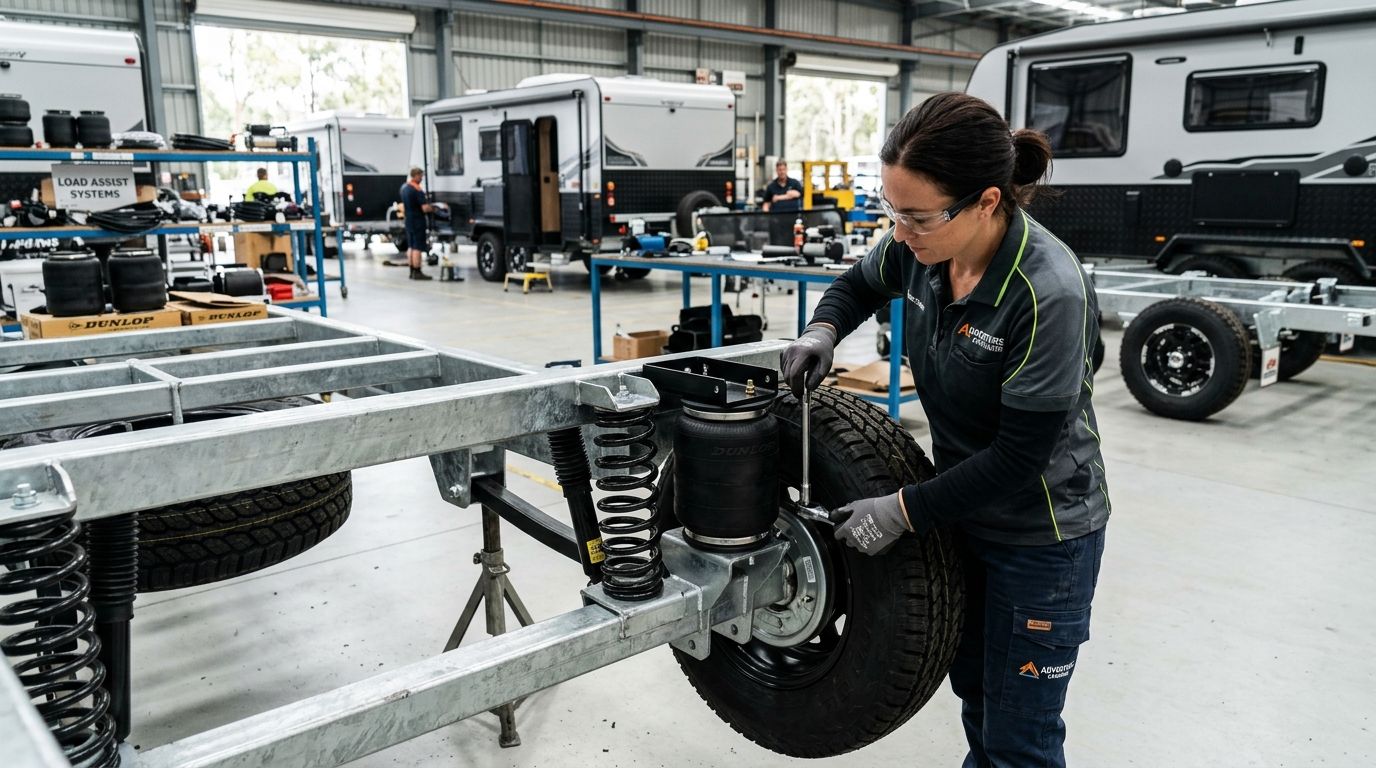
Load assist airbags for caravan manufacturers are vehicle-specific air suspension kits fitted to demonstration vehicles, tow-tugs and buyer-owned tow vehicles before caravan handover, designed to reduce rear-end sag and keep the tow vehicle more level once a caravan is hitched up. Caravan manufacturers deal with a wider spread of tow vehicles than a single owner ever will, so fitment accuracy and a repeatable install process across that range matter more than they do for one retail sale.
- Load assist airbags for caravan manufacturers work best specified per tow-vehicle model, not as one universal kit across a mixed fleet.
- Boss Air Suspension supplies vehicle-specific load assist kits for common caravan tow vehicles, including Ford Ranger and Mercedes Sprinter-based platforms.
- Adjustable air pressure lets pre-delivery staff set ride height for the actual caravan being handed over, not a generic setting.
- Documented warranty and Australian support reduce comeback risk when one kit choice sits behind dozens of handovers a year.
Why this matters for caravan manufacturers
A buyer standing on your showroom floor in 2026 usually asks one practical question before signing: will my tow vehicle sit level once this van is hitched up? That question is harder to answer well when your dealership network sells the same caravan behind a dozen different utes, wagons and vans.
Tow-ball weight changes with caravan configuration. A single-axle van, a tandem-axle van and a fifth-wheeler load the rear of a tow vehicle very differently, and each needs a different air pressure setting rather than a single fixed answer.
Manufacturers that treat load assist as a one-size-fits-all accessory tend to generate more warranty calls and more unhappy pre-delivery inspections than manufacturers that match the kit to the vehicle. Getting this right at the manufacturing or dealership level protects the sale, not just the ride. A caravan that arrives with a documented caravan dealership pre-delivery setup gives the buyer a level tow vehicle and a clear record of the pressure it was set at.
Boss Air Suspension's vehicle-specific load assist kits are the practical choice for caravan manufacturers that need consistent, documented fitment across a mixed tow-vehicle range.
How to fit load assist airbags across a caravan manufacturer's tow-vehicle range
Match kits to each tow vehicle in your range
Start with a list of every tow vehicle your buyers actually turn up in, not just the ones you recommend. Manufacturers who skip this step end up guessing at fitment on the pre-delivery bay floor, which slows handovers.
- List every make and model your caravan range is commonly towed by.
- Check factory GVM and rear axle rating for each vehicle before assuming a kit will suit.
- Note wagon, dual-cab ute and van variants separately, since suspension geometry differs even within one model name.
- Flag any vehicle with an existing GVM upgrade, as bracket selection can change.
- Cross-reference vehicle-specific fitment guides rather than relying on a universal bracket kit.
Once the list is built, caravan airbag suspension kits can be assigned model-by-model instead of guessed at on the day.
Confirm ride height before you hitch up a demo caravan
A demonstration vehicle that sits nose-up or rear-down with no van attached tells you nothing useful about how it will behave loaded. Check unladen ride height first, every time.
- Measure ride height at all four corners with no load in the tray or boot.
- Record the measurement so it can be compared after the airbag kit goes in.
- Check tyre pressures match the vehicle placard before measuring, since under-inflated tyres skew the reading.
- Repeat the measurement after fitment and again once the caravan is hitched.
Choose the right bellow type for tow-ball weight
Not every caravan in a manufacturer's range puts the same load on the tow vehicle. A pop-top single-axle van and a full-height tandem-axle tourer are different jobs.
- Work out the caravan's ball weight from its compliance plate, not an estimate.
- Match single or double bellow airbags to that ball weight range rather than defaulting to one bag across the whole fleet.
- Check bracket compatibility with the existing coil or leaf spring setup on the tow vehicle.
- Confirm the kit is a bolt-on design that works with the factory suspension rather than replacing it.
Set air pressure for the caravan actually being handed over
This is the step manufacturers most often skip, and it is the one buyers notice fastest. A single fixed pressure setting on delivery day does not suit every van on the lot.
- Weigh or confirm the specific caravan's ball weight before setting pressure.
- Adjust air pressure at pre-delivery to suit that load, not a default figure.
- Show the buyer how to adjust pressure themselves for future trips with a lighter or heavier load.
- Note the recommended pressure range on the handover paperwork.
- Where volume justifies it, fit a digital air controller so pressure can be checked without a gauge and hand pump at every changeover.
Standardise the bolt-on installation across your service bays
Consistency across fitters matters as much as the kit itself. A vehicle-specific kit that goes in wrong wastes the fitment work done in step one.
- Use a written installation checklist per vehicle model rather than relying on memory.
- Confirm airline routing is clear of heat sources and moving suspension components.
- Bleed and reset the system after installation before the first test drive.
- Torque brackets to the same spec every time, and record it.
Document warranty and support details in the handover pack
A buyer who tows interstate needs to know who to call if something changes. Manufacturers that build this into the standard handover pack get fewer follow-up calls to the factory.
- Include the airbag kit's warranty terms in the caravan's own handover documentation.
- Note the vehicle-specific kit fitted, not just "load assist airbags" generically.
- Provide a contact point for technical support beyond your own dealership network.
- Keep a record of the fitted pressure range for future reference.
Boss Air Suspension backs its load assist kits with a five-year warranty and Australian-based technical support, which matters at manufacturer scale where one kit choice sits behind many handovers rather than one.
Comparison: load assist options for caravan manufacturers
| Option | Best for | Key limitation | Verdict |
|---|---|---|---|
| Universal aftermarket airbag kit | Low-volume, one-off fitments | Bracket fit and ride height often need on-the-day workarounds | Skip for fleet use |
| Boss Air Suspension vehicle-specific load assist kit | Manufacturers fitting a known set of tow-vehicle models | Requires a documented list of tow vehicles per caravan model | Buy for repeat handovers |
| Coil assist kit | Buyers who prefer not to add air lines | Less adjustable than an airbag kit once fitted | Hold, offer as an alternative not a default |
| Air strut suspension kit | Tow vehicles already running air struts | Not suited to standard coil or leaf-sprung utes | Hold, vehicle-specific only |
| Trailer-side air suspension on the caravan chassis | Fifth-wheelers and heavier tandem-axle vans | A separate system to the tow vehicle's load assist kit | Buy where van weight demands it |


Common mistakes caravan manufacturers make
- Fitting one universal kit across the whole tow-vehicle range instead of matching kits model-by-model, which shows up as inconsistent ride height across the fleet.
- Setting pressure once and never adjusting it per caravan. A tandem-axle van and a pop-top do not put the same weight on the tow ball.
- Skipping the bleed-and-reset step after installation, which leaves air trapped in the lines and gives an inaccurate first ride height reading.
- Leaving warranty details out of the buyer's handover pack, which pushes support calls back to the manufacturer months later.
- Treating the caravan chassis and the tow vehicle as one system. A tow vehicle's load assist kit does not address sag in a heavy trailer's own axle group.
FAQ
What are load assist airbags for caravan manufacturers?
They are vehicle-specific air suspension kits fitted to a caravan's likely tow vehicles to reduce rear-end sag and help keep the vehicle more level when towing. Manufacturers use them on demo vehicles and as a pre-delivery fitment across their tow-vehicle range.
Do load assist airbags increase towing capacity?
No. Load assist airbags improve ride height, stability and comfort under load but do not increase a vehicle's legal payload, GVM or towing capacity. Any capacity change requires an approved GVM upgrade with its own documentation.
Can one load assist kit fit multiple tow vehicles?
No, kits are vehicle-specific because bracket mounting points, ride height and bellow size differ between models. A kit built for one ute or van will not bolt straight onto a different model.
How much air pressure should a caravan tow vehicle run?
Pressure depends on the caravan's actual ball weight, so there is no single correct number across a manufacturer's range. Pre-delivery staff should set pressure to the specific van being handed over and note it on the paperwork.
Is a coil assist kit better than an airbag kit for caravan towing?
Coil assist kits suit buyers who want a simpler setup without air lines, while airbag kits give adjustable pressure for varying loads. Airbag kits are usually the better default for a manufacturer supplying buyers with different caravan weights.
What is the difference between load assist airbags and air suspension on the caravan chassis?
Load assist airbags fit to the tow vehicle's rear suspension, while trailer or caravan-side air suspension is a separate system on the caravan's own axle group. Heavier tandem-axle and fifth-wheeler vans sometimes use both.
How long does a load assist kit take to install?
Installation time varies by vehicle and bracket design, so confirm timing with your fitting bay rather than assuming a fixed figure. A written per-model checklist keeps install times consistent across a service team.
Are Boss Air Suspension load assist kits covered by warranty?
Boss Air Suspension backs its load assist kits with a five-year warranty and Australian-based support. That matters for manufacturers fitting the same kit across many handovers rather than a single sale.
One last thing
The detail most caravan manufacturers miss is that pressure needs resetting whenever a buyer changes what they are towing, not just once at handover. A buyer who moves from a pop-top to a tandem-axle tourer next year is running the wrong pressure unless someone tells them to adjust it. Building that reminder into your handover pack costs nothing and prevents most of the comeback calls tied to load assist kits in 2026.